Best Metal Detector Checkweigher for 2026 Trends and Innovations?
In the rapidly evolving landscape of quality control, the role of the Metal Detector Checkweigher stands out. As industries shift towards automation and precision, these devices are becoming crucial in maintaining product integrity. Expert Richard Lane, a leading figure in manufacturing technology, once stated, “The right Metal Detector Checkweigher can redefine efficiency in production lines.”
This statement embodies the potential innovations for 2026. Advanced algorithms and machine learning are transforming how these machines operate. The growing demand for safety in food and pharmaceuticals drives interest in improved detection capabilities. Companies seek to integrate these technologies seamlessly into existing workflows.
Nevertheless, challenges remain. Many industries grapple with outdated systems. Bridging that gap requires significant investment and training. Innovators must focus on user-friendly designs that accommodate diverse skill levels. The future of Metal Detector Checkweigher technology seems promising but must address these imperfections to maximize operational benefits.

Best Metal Detector Checkweigher Technology in 2026
In 2026, the technology surrounding metal detector checkweighers is set to evolve significantly. Industry reports indicate that automation and artificial intelligence (AI) will play crucial roles. These advancements improve detection accuracy and enhance efficiency in production lines. High sensitivity detectors will likely become standard, detecting metal contaminants smaller than ever.
Data from market analysts show that the demand for these machines is rising. The global metal detector checkweigher market is projected to grow by 7% annually. This growth is driven by increasing safety regulations in the food and pharmaceutical industries. Companies must ensure that their products are contaminant-free, pushing them toward advanced technology solutions.
Tips: Regular maintenance checks are vital for ensuring optimal performance. Malfunctions can lead to false readings or undetected contaminants. Investing in training for staff on these advancements is essential for maximizing productivity and safety. This helps in maintaining compliance with regulatory standards.
While innovations are promising, challenges also remain. Integrating new technologies requires time and careful planning. Staff might resist changes, leading to implementation delays. Continuous feedback loops will be necessary to refine processes and improve user experience. Addressing these concerns early will pave the way for smoother transitions in technology upgrades.
Key Innovations in Metal Detector Checkweigher Designs
The metal detector checkweigher market is evolving rapidly. Key innovations are shaping designs for enhanced efficiency. In 2026, expect more integration of AI technology. AI can analyze metal detection data in real-time. This provides immediate feedback on product quality. Manufacturers are also focusing on miniaturization. Smaller devices can fit into tight production spaces while maintaining accuracy.
Recent reports suggest that the demand for precision in food and pharmaceutical industries is surging. A study indicated that 70% of companies prioritize reliability in metal detection. This trend pushes innovations that enhance detection capabilities. Advanced sensors are now standard. They can detect even the tiniest contaminants, improving safety.
**Tip:** Regular calibration of checkweighers increases accuracy. Schedule maintenance to avoid unexpected downtime. Also, consider more user-friendly interfaces. Operators often struggle with complex systems. An intuitive design can lead to increased efficiency. Reflect on your current processes. Can they be simplified? Continuous improvement is necessary for success.
Best Metal Detector Checkweigher for 2026 Trends and Innovations
| Feature |
Trend |
Innovation |
Impact on Industry |
| High Sensitivity Detection |
Increased demand for precision |
Advanced sensor technologies |
Improved product safety and compliance |
| Real-time Data Analytics |
Automation in quality control |
AI-driven decision making |
Streamlined operations and reduced waste |
| Compact Design |
Space optimization in facilities |
Modular equipment configurations |
Enhanced flexibility in processing lines |
| User-friendly Interfaces |
Increased operator efficiency |
Touchscreen and mobile applications |
Reduced training time and errors |
| Integration with IoT |
Shift towards smart manufacturing |
Connected devices for monitoring |
Enhanced data collection and reporting |
Trends Shaping the Future of Metal Detector Checkweighers
The metal detector checkweigher industry is seeing exciting trends as we approach 2026. With the global market expected to grow by 6.2% annually, innovations are essential. Enhanced sensitivity is becoming a priority. Many industries require precise detection of contaminants in food and pharmaceuticals. According to recent reports, about 56% of contamination incidents stem from undetected metals. This reality drives the need for advanced checkweighers.
Integration of AI technology is another significant trend. AI can analyze data more effectively, improving detection rates. Companies are adopting smart systems to reduce false rejects, which currently account for 15-20% of total output. These improvements are not just about technology; they also require a thoughtful approach to implementation. Training personnel to use these tools is crucial, yet often overlooked.
Sustainability is also shaping innovations. Many manufacturers are exploring eco-friendly materials for machines and packaging. This is not just a trend; it's a necessity due to increasing environmental regulations. However, the initial costs can be a barrier to adoption for smaller businesses. Balancing sustainability and profitability is a challenge that requires careful consideration.
Impact of Automation on Metal Detector Checkweighers in 2026
The future of metal detector checkweighers is heavily influenced by automation trends. In 2026, automated systems are expected to dominate the market. A recent industry report indicated that automation could improve accuracy by 30%. This enhancement will help companies ensure compliance and prevent costly recalls. High-speed production lines require precision, and automation provides that.
However, challenges remain. Not all automated systems can adapt to different product types. Some machines struggle with irregular shapes or weights, leading to potential errors. Data shows that 15% of users have reported issues with product variability. Overcoming this requires ongoing innovation in sensor technology and software integration.
Integration with AI is also becoming essential. AI can analyze real-time data to enhance decision making. Predictive maintenance is another area where AI shines, reducing downtime significantly. Yet, the reliance on technology raises concerns. What if systems fail due to software bugs? This unpredictability demands continuous assessment and refinement of automated processes. The focus must be on creating resilient systems capable of addressing these potential pitfalls.
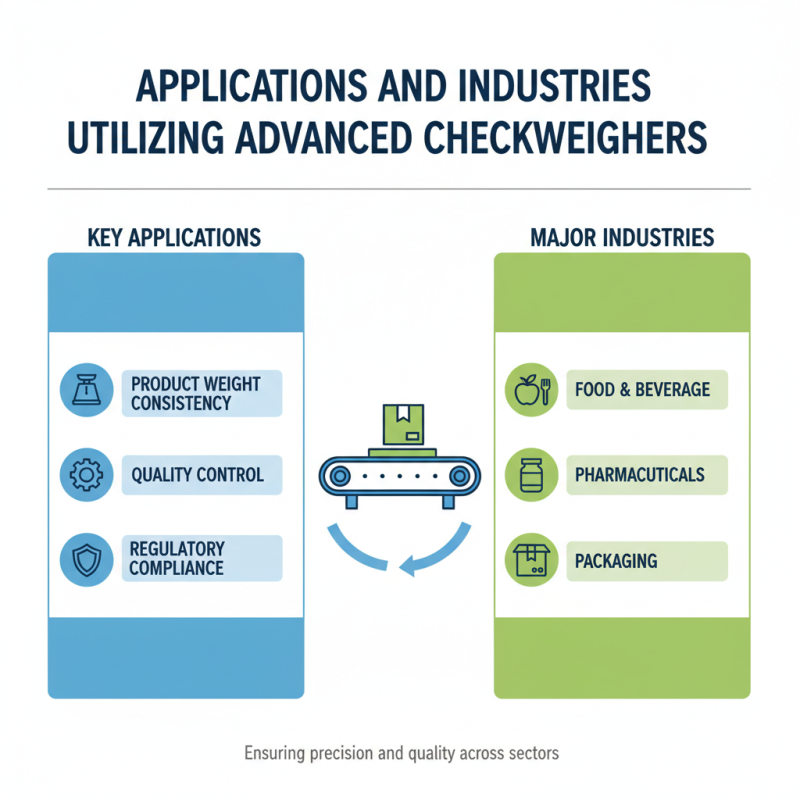
Applications and Industries Utilizing Advanced Checkweighers
In the fast-evolving landscape of manufacturing and packaging, advanced checkweighers are gaining traction. These machines play a critical role in ensuring product quality across various industries. From food and beverage to pharmaceuticals, their applications are diverse. They help maintain consistency in product weight, thereby ensuring compliance with regulations.
Companies in food processing benefit from checkweighers significantly. They ensure portions are accurate and reduce waste. In pharmaceuticals, precise measurements are vital. Any miscalculation can have serious consequences. Thus, checkweighers help guarantee that every package meets industry standards.
However, there are challenges. Not every checkweigher is foolproof. Some may struggle with certain products that vary in size or texture. Manufacturers must regularly test their machines to ensure accuracy. It's crucial for industry players to stay updated with trends and innovations in this field, as technology continues to evolve rapidly. By embracing these advancements, companies can enhance their operational efficiency and product reliability.